
It’s 3:14 AM. You’re wide awake, staring at the ceiling, wondering if the hum of the refrigerator has always been this aggressive. Your skin feels three sizes too small, there’s a phantom heat rising from your chest that could power a small village, and your brain is currently a thick soup of tomorrow’s To-Do list and that one embarrassing thing you said in 2004.
Welcome to the perimenopause night shift. It’s a joyless club with terrible snacks.
By the time 7:00 AM rolls around, the idea of "crushing a workout" feels less like a fitness goal and more like a personal insult. You’re exhausted, your joints feel like they’ve been replaced with rusty hinges, and the brain fog is so dense you’ve forgotten where you keep the spoons.
Most fitness "influencers" would tell you to "grind through it" or "find your why." I’m here to tell you that’s a great way to end up crying in your car or accidentally throwing a 10lb dumbbell through your television.
The reality is that your body is navigating a massive hormonal overhaul. You aren’t "failing" because you’re tired; you’re adapting. But, and this is the part where the coach in me comes out, being tired isn't a permanent pass to retire to the sofa for the next five years.
Here is how we train when the hormones are screaming and the sleep is non-existent.
The Great Debate: Listening to Your Body vs. Making Excuses
This is the trickiest part of coaching women over 40. We’ve been told for decades to "push harder," but perimenopause is the phase where your body starts pushing back.
How do you know the difference between being genuinely, physiologically depleted and just… really not feeling it?
Genuine Exhaustion:
- You feel dizzy or lightheaded when you stand up.
- Your resting heart rate is noticeably higher than usual.
- The thought of a workout makes you feel physically nauseous or like you’re about to burst into tears.
- You’ve had less than four hours of fragmented sleep for three nights in a row.
The "Excuses" (or Brain Fog Laziness):
- You’re bored.
- You’re annoyed that you aren't seeing results fast enough.
- You’ve decided that because you can't do your best workout, you shouldn't do any workout.
- You’re waiting for "motivation" to strike (spoiler: it isn't coming).
In my 20+ years of training, I’ve found that if you can get through five minutes of movement, the "excuses" usually evaporate. If, after five minutes, you still feel like a zombie in yoga pants, then you’re genuinely exhausted. At that point, we pivot. We don’t quit.
Enter the 'Minimum Viable Dose' (MVD)
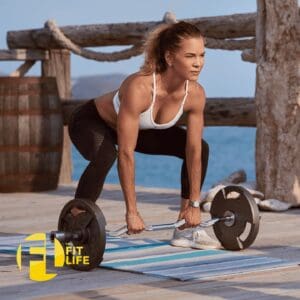
When you’re well-rested and firing on all cylinders, we do the Wake Up With Weights routine, the heavy lifting, the high intensity, the stuff that makes you feel like a warrior.
But on the mornings when you feel like a damp rag? We switch to the Minimum Viable Dose.
The MVD is the smallest amount of work you can do to maintain the habit, keep your joints lubricated, and tell your nervous system that you are still in charge. It’s not about building a PR; it’s about not losing the ground you’ve already won.
Think of it like this: If your fitness is a fire, the MVD is the pilot light. It doesn't need to be a bonfire every day, but we cannot let the flame go out.
What an MVD session looks like:
- 10 Minutes of Mobility: Not "yoga on a beach" nonsense, just functional movement. Cat-cow, some thoracic rotations, maybe a few bird-dogs.
- The "Big Three" at 50%: One set of squats, one set of pushes (push-ups or overhead press), and one set of pulls (rows). Use a weight that feels like a 5 out of 10.
- A 15-Minute Walk: Outdoor light is arguably the best medicine for perimenopausal brain fog and circadian rhythm disruption.

Consistency Over Intensity (Always)
I see it all the time: a woman misses two weeks of training because she’s "too tired," then tries to make up for it by doing a 90-minute "Friday Fix" style blast when she’s still sleep-deprived.
This is a recipe for disaster.
In perimenopause, your cortisol (the stress hormone) is already doing backflips. If you add high-intensity, high-volume stress to a body that hasn't slept, you aren't burning fat, you’re telling your body to go into lockdown mode. Your recovery will stall, your inflammation will spike, and you’ll likely end up with an injury that sidelines you for a month.
Strength training for perimenopause is about playing the long game. A 15-minute mediocre workout performed three times a week is infinitely more valuable than one "perfect" workout every fortnight.
We are not here to play; we are here to build a body that can handle the aging process. That requires showing up, even when you’re showing up at 40% capacity.
Recovery Strategies That Aren’t Scams
If you see an ad for a "menopause detox tea," I want you to run in the opposite direction. Your liver and kidneys handle detoxification for free. That tea is just a laxative in a fancy box, and the last thing a sleep-deprived, dehydrated woman needs is… well, you get the idea.
Real recovery for the perimenopausal athlete looks like this:
1. The Protein Priority
Muscle is your metabolic currency. As we age and estrogen drops, our bodies become less efficient at processing protein. You need more of it than you think. Aim for 25–40g per meal. It helps with satiety, muscle repair, and stabilizing the blood sugar swings that often contribute to 3 AM wake-ups. (Read more on why resistance training matters for bone density here).
2. Magnesium (The Unsung Hero)
Most of us are deficient. Magnesium glycinate before bed can help settle the nervous system and potentially reduce the "restless leg" feeling that keeps so many women awake. It’s not a magic pill, but it’s a hell of a lot better than a detox tea.
3. Temperature Control
If hot flashes are your primary sleep thief, you need to turn your bedroom into a meat locker. Cold room, weighted blanket (if you can stand it), and moisture-wicking pajamas.
4. Stop the "Afternoon Caffeine" Lie
You think that 3 PM espresso is helping you get through the workday. It’s actually just ensuring you’ll be staring at the ceiling again tonight. Caffeine has a half-life of about 5–6 hours. If you have a cup at 4 PM, half of it is still buzzing in your system at 10 PM. Switch to herbal or just deal with the yawn.
The Rebrand: It’s a Phase, Not a Life Sentence
I’ve said it before: The menopause rebrand is necessary. We need to stop looking at this stage of life as the beginning of the end. It’s just a change in the operating system.
Your "Effort Never Ends," but the way you apply that effort has to evolve.
If you’re struggling to figure out how to bridge the gap between "exhausted" and "fit," don't go it alone. Whether it's a ClassCard™ for flexibility or one-on-one coaching to work around your specific injuries and limitations, there’s a way to keep moving.
Tomorrow morning, if the alarm goes off and you feel like you’ve been hit by a truck, don't hit snooze for two hours. Get up. Do ten minutes of mobility. Walk around the block. Keep the pilot light on.
You aren't a broken appliance. You’re just a woman who needs a better strategy.
Now, go drink some water and put the weights down if you’re actually dizzy. Otherwise? I’ll see you in class.